

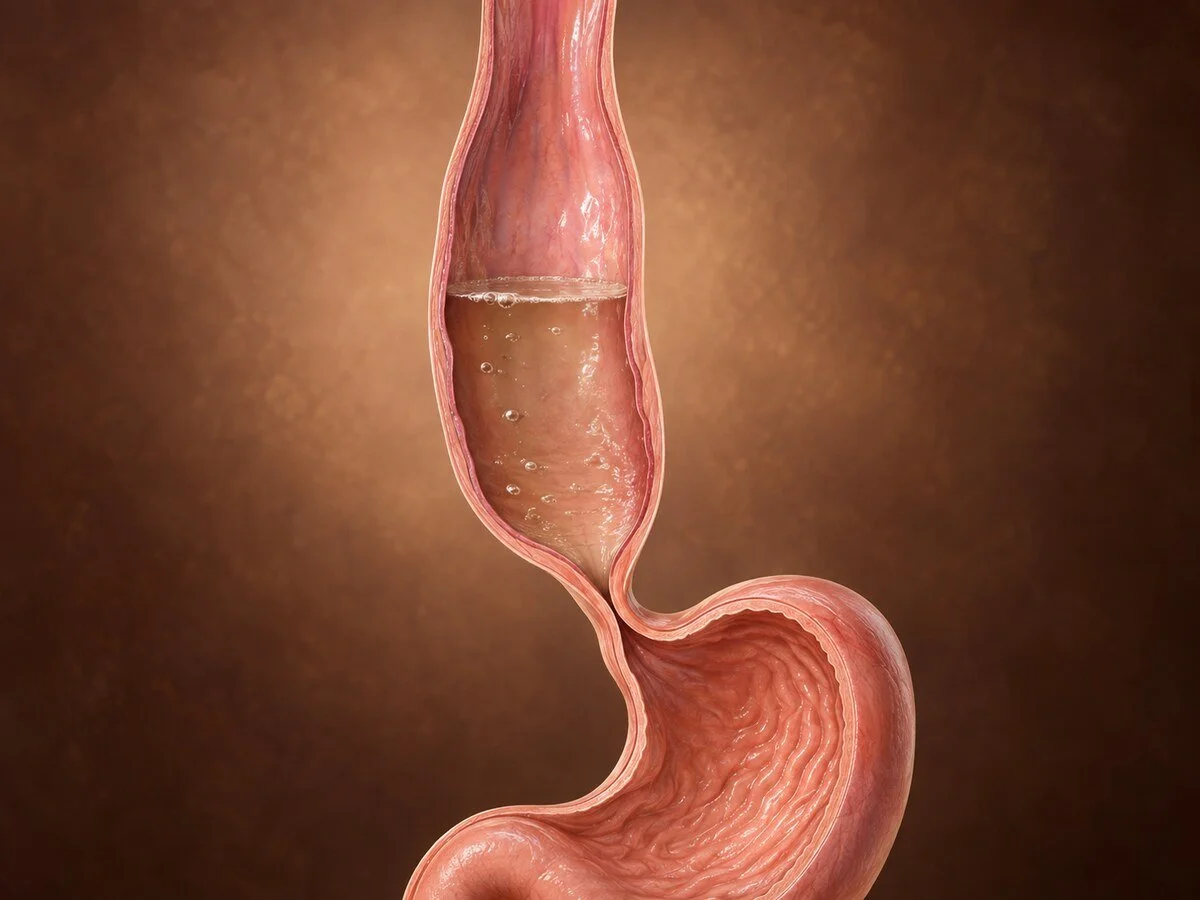
Achalasia is a disorder in which the oesophagus loses its ability to propel food downward and the valve at its lower end fails to relax. Food and liquid accumulate above a functionally closed sphincter. It is uncommon, it is frequently misdiagnosed as reflux for years before it is recognised, and it is very treatable once identified.
How it forms
Swallowing depends on the myenteric (Auerbach's) plexus, a network of nerve cells within the oesophageal wall. It contains both excitatory neurones, which contract muscle, and inhibitory neurones, which release nitric oxide and vasoactive intestinal peptide to relax it. Coordinated peristalsis and sphincter relaxation require both.
In achalasia the inhibitory neurones are selectively destroyed. The consequences follow directly: without inhibitory input the lower oesophageal sphincter cannot relax, so it remains tonically closed; and without the inhibitory gradient that sequences contraction down the oesophagus, peristalsis is lost. Excitatory neurones are relatively spared, which is why some patients have vigorous, uncoordinated contractions rather than none at all.
The destruction appears to be immune-mediated, possibly triggered by viral infection in a genetically susceptible individual, with inflammatory infiltration of the plexus followed by loss of ganglion cells and fibrosis. The trigger is not established, and patients should be told honestly that the cause is unknown.
Over time the obstructed oesophagus dilates and, in advanced disease, becomes tortuous and sigmoid.
Pseudoachalasia must always be considered: a tumour at the gastro-oesophageal junction, or infiltration by cancer elsewhere, can produce identical findings. Short history, older age, marked weight loss and difficulty passing the endoscope through the junction all raise suspicion. Chagas disease produces the same picture through destruction of the plexus by Trypanosoma cruzi, and is relevant in patients from Latin America.
Symptoms
Dysphagia to both solids and liquids — the characteristic feature. Mechanical obstruction typically affects solids first; achalasia affects both from the outset.
regurgitation of undigested, non-acidic food, often hours after eating and at night
chest pain
weight loss
heartburn — confusingly common, caused by fermentation of retained food rather than acid reflux, which is why patients are so often treated for reflux without benefit
nocturnal cough or recurrent chest infections from aspiration
adaptive behaviours: eating slowly, drinking large volumes to wash food down, standing or arching to aid emptying
How the diagnosis is made
High-resolution manometry is the definitive test. It demonstrates absent peristalsis with impaired relaxation of the lower sphincter, and classifies achalasia into three subtypes by the Chicago classification: type I (no contractility), type II (pan-oesophageal pressurisation), type III (spastic). The subtype predicts response to treatment — type II does best with any treatment, type III responds better to myotomy than to dilatation.
Barium swallow shows a dilated oesophagus tapering to the classical "bird's beak" at the junction, with delayed emptying. A timed barium swallow quantifies emptying and is useful for follow-up.
Endoscopy is mandatory, principally to exclude pseudoachalasia. Retained food and a tight but passable junction are typical; endoscopic ultrasound or CT is added where malignancy is suspected.
Treatment
No treatment restores peristalsis. All treatments reduce the resistance at the lower sphincter so that gravity can empty the oesophagus. Patients should understand this, because it explains why symptoms improve but swallowing never becomes entirely normal.
Laparoscopic Heller myotomy with partial fundoplication
The muscle of the lower oesophagus and upper stomach is divided longitudinally, leaving the mucosa intact, over a length of some 6cm on the oesophagus and 2–3cm onto the stomach. A partial fundoplication — usually anterior (Dor) or posterior (Toupet) — is added to limit the reflux that inevitably follows destruction of the sphincter. A full wrap is not used, because an oesophagus without peristalsis cannot push through it.
Durable results in the large majority, and the standard against which other treatments are measured.
Peroral endoscopic myotomy (POEM)
An endoscopic myotomy performed through a submucosal tunnel, with no skin incisions. Results for symptom relief are comparable to surgery, and it has particular advantages in type III achalasia, where a longer myotomy extending up the oesophageal body is possible. Its drawback is a higher rate of reflux, because no antireflux procedure accompanies it, and patients frequently require long-term acid suppression.
Pneumatic balloon dilatation
Graded dilatation of the sphincter with a large balloon. Effective, particularly in older patients and in type II disease, but often requires repeated sessions, and carries a small risk of perforation.
Botulinum toxin injection
Blocks acetylcholine release, relaxing the sphincter temporarily. Effect lasts months rather than years. Reserved for patients unfit for definitive treatment, as it also causes scarring that can make later myotomy more difficult.
Oesophagectomy
Reserved for end-stage disease with a massively dilated, sigmoid oesophagus that fails to empty despite adequate myotomy.
Recovery
After laparoscopic myotomy, hospital stay is typically one to two nights, with a contrast study before feeding in many units. A soft diet is followed for two to four weeks and normal activity resumes within two to three weeks. Relief of dysphagia is usually immediate and marked.
Follow-up
Long-term. Symptoms can recur years later, and reflux after treatment requires monitoring and often treatment, as untreated reflux in an oesophagus that cannot clear itself carries a risk of Barrett's change. There is a small long-term increase in the risk of oesophageal squamous cancer in achalasia, which informs the threshold for repeat endoscopy.
Common questions
Why was I treated for reflux for so long?
Because achalasia frequently causes heartburn, from food fermenting in the oesophagus rather than from acid. Combined with chest pain and regurgitation, it looks like reflux. The distinguishing feature is difficulty swallowing liquids as well as solids, and the test that settles it is a manometry study.
Is achalasia cancer?
No, it is a disorder of the nerves controlling the oesophagus. However, a tumour at the lower end of the oesophagus can produce an identical picture, which is why an endoscopy is always performed before treatment.
Can it be cured?
The nerve damage cannot be reversed and the oesophagus will not regain normal squeezing action. But treatment relieves the obstruction very effectively, and most people eat normally again and maintain their weight. Think of it as well controlled rather than cured.
Surgery or POEM — which is better?
Both relieve symptoms comparably. Surgery includes a partial wrap that limits reflux; POEM avoids incisions and allows a longer myotomy, which suits the spastic subtype, but causes more reflux and often means taking acid-suppressing tablets afterwards. The choice depends on your manometry subtype, your anatomy and your preferences.
Will I be able to eat normally afterwards?
Most people eat a normal diet after treatment. Because the oesophagus still does not squeeze, food travels down largely by gravity, so eating upright, chewing well and drinking with meals continue to help.
Will it come back?
Symptoms can return years later, and some patients need a second treatment. Regular follow-up is recommended, both to detect recurrence and to monitor for reflux, which is a recognised consequence of every effective treatment.
Related conditions
Other conditions of the oesophagus covered on this site:
This page provides general information and does not replace an individual medical consultation. Assessment and treatment are decided for each patient after review of their history, examination and investigations.
