

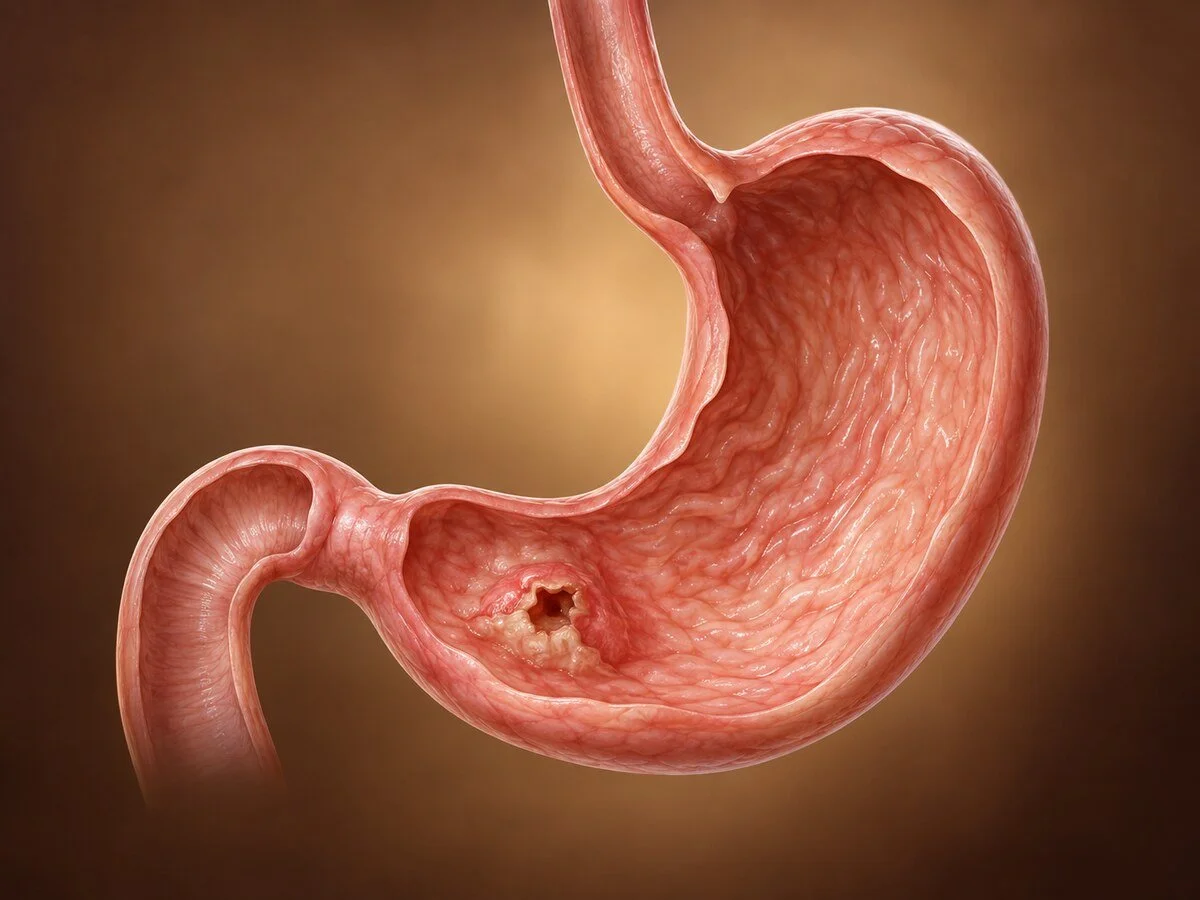
Perforation and bleeding are the two emergency complications of peptic ulcer disease. Between them they account for almost all the surgery still performed for ulcers. Both are treatable and both are time-critical, and in both the outcome depends less on the technical difficulty of the intervention than on how quickly the patient reaches definitive treatment.
How they happen
An ulcer is a defect that erodes progressively deeper through the wall. What happens next depends on the direction in which it erodes.
Perforation occurs when the ulcer erodes through the full thickness of the wall into the peritoneal cavity. This is commonest on the anterior wall of the duodenum or the anterior stomach, where there is no adjacent organ to plug the defect. Gastric and duodenal contents — acid, bile, enzymes, food and bacteria — spill into the peritoneum, producing first an intense chemical peritonitis and, within hours, bacterial peritonitis and sepsis.
Bleeding occurs when the ulcer erodes posteriorly into a vessel rather than forward into the cavity. The classical and most dangerous example is a posterior duodenal ulcer eroding the gastroduodenal artery, which lies directly behind the first part of the duodenum. A gastric ulcer on the lesser curve may erode the left gastric artery. These are substantial arteries, and bleeding from them is rapid.
Penetration is the third possibility: the ulcer erodes into an adjacent organ — pancreas, liver, colon — which seals the defect. It presents as persistent, changed pain, classically boring through to the back when the pancreas is involved, rather than as an acute emergency.
The same risk factors drive both complications: Helicobacter pylori, NSAIDs and aspirin, smoking, and increasing age. Anticoagulants and antiplatelet drugs do not cause ulcers but greatly increase the severity of bleeding from one. A substantial proportion of patients presenting with perforation or haemorrhage have had no previous ulcer symptoms whatsoever, particularly older patients taking anti-inflammatory tablets.
Perforated ulcer
Symptoms
The history is characteristic and its sudden onset is the key feature.
Sudden, severe, generalised abdominal pain — patients can usually state the exact moment it began
pain worse on any movement, so the patient lies still, in contrast to the restlessness of colic
pain referred to the shoulder tip, from diaphragmatic irritation
a rigid, board-like abdomen with generalised guarding and rebound tenderness
tachycardia, then fever and hypotension as sepsis develops
In the frail, the elderly and those on steroids the signs may be muted and the presentation late, which is one reason mortality is concentrated in that group.
Diagnosis
An erect chest X-ray showing free gas under the diaphragm confirms the diagnosis in most cases, but its absence does not exclude it. CT is considerably more sensitive and is the investigation of choice: it detects small volumes of free gas, localises the perforation, and identifies alternative diagnoses. Blood tests show raised inflammatory markers, and amylase may be moderately raised — a trap, as it can suggest pancreatitis.
Treatment
Resuscitation begins immediately: intravenous fluids, broad-spectrum antibiotics, a nasogastric tube, a proton pump inhibitor, analgesia and urinary catheterisation.
Surgery is the standard treatment. The operation is straightforward in principle: wash out the peritoneal cavity thoroughly, and close the perforation. A duodenal perforation is typically closed with sutures and covered with an omental patch, or plugged with omentum where the tissue is friable. A gastric perforation is closed similarly, but must be biopsied, because a proportion prove to be perforated gastric cancers; a large or suspicious gastric perforation may require resection.
Laparoscopic repair is well established, reduces wound complications and pain, and is appropriate for most patients who are haemodynamically stable.
Non-operative management — antibiotics, nasogastric drainage and close observation — is an option in a carefully selected minority: a stable patient with a contained, sealed perforation confirmed on contrast study, with localised rather than generalised peritonitis. It requires vigilant reassessment and a low threshold for operating, and it is not a substitute for surgery in the unstable patient.
H. pylori testing and eradication follow, since the ulcer disease itself remains untreated by the repair.
Bleeding ulcer
Symptoms
Haematemesis — vomiting blood, either fresh or altered to resemble coffee grounds
Melaena — black, tarry, offensive stool, indicating blood that has been digested. This is upper gastrointestinal bleeding until proved otherwise.
fresh rectal bleeding, which in the context of shock indicates very brisk upper bleeding rather than a lower source
dizziness, collapse, breathlessness, chest pain
tachycardia and hypotension; in chronic slow bleeding, iron-deficiency anaemia alone
Assessment and initial treatment
Resuscitation takes priority over diagnosis. Large-bore intravenous access, blood samples including group and crossmatch, and fluid or blood replacement. Restrictive transfusion — transfusing to a haemoglobin threshold around 70–80 g/L rather than higher — produces better outcomes than liberal transfusion in most patients. Anticoagulation is reviewed and reversed where the bleeding is life-threatening, balancing this against the reason it was prescribed.
Scoring systems guide urgency: the Glasgow-Blatchford score identifies patients at very low risk who may be managed as outpatients, and the Rockall score estimates rebleeding and mortality risk after endoscopy.
Endoscopy
Endoscopy within twenty-four hours is the standard, and earlier in unstable patients once resuscitated. It establishes the diagnosis, gives prognostic information through the appearance of the ulcer base (the Forrest classification), and provides treatment.
Ulcers with active spurting or oozing, a visible vessel, or an adherent clot require endoscopic therapy. Ulcers with a clean base do not, and those patients can often be fed and discharged early.
Endoscopic treatment uses at least two modalities in combination, which is more effective than any single one: adrenaline injection to slow the bleeding and allow a view, combined with thermal coagulation, clips, or haemostatic powder. Over-the-scope clips are increasingly used for large vessels and for rebleeding.
High-dose intravenous proton pump inhibitor is given after endoscopic treatment, and reduces rebleeding.
When endoscopy fails
Rebleeding occurs in a minority and a second endoscopy is usually appropriate. Where that fails, or where bleeding is torrential:
Transcatheter arterial embolisation — the interventional radiologist occludes the feeding vessel, most often the gastroduodenal artery. This has become the preferred second-line treatment in most units, and avoids surgery in the majority.
Surgery — for a bleeding duodenal ulcer, the duodenum is opened and the vessel under-run with sutures placed above, below and medial to it, to control the gastroduodenal artery and its transverse pancreatic branch. For a bleeding gastric ulcer, the ulcer is excised or under-run, and biopsied. Gastrectomy is now rarely required.
Recovery
After laparoscopic repair of a perforation in a patient who presented early, hospital stay is often three to six days and recovery to normal activity four to six weeks. Late presentation with established peritonitis and sepsis is a different matter: critical care, a longer stay, and a recovery measured in months.
After a bleeding ulcer treated endoscopically, patients are usually eating within a day or two and home within a few days, on a proton pump inhibitor.
Follow-up
Three things must happen after either complication, and each is sometimes overlooked in the relief of the patient's recovery:
Test for and eradicate H. pylori, and confirm eradication afterwards.
Review all medication — stop the NSAID where possible; plan gastroprotection where aspirin or anticoagulation must continue.
Repeat endoscopy for gastric ulcers to confirm healing and exclude cancer.
Smoking cessation is advised for the same reasons as in uncomplicated disease.
When to seek help urgently
Sudden severe abdominal pain, vomiting blood, or black tarry stools all require emergency assessment. Not the next available appointment — the same hour.
Common questions
I had no symptoms at all. How can I have had an ulcer?
This is common, particularly in older people and in those taking anti-inflammatory painkillers, which reduce pain generally and can mask the ulcer they are causing. A significant proportion of people who present with a perforation or a bleed had never had indigestion.
How serious is a perforated ulcer?
It is a serious emergency, but it is very treatable when dealt with promptly. The operation itself is straightforward — washing out the abdomen and closing the hole, usually through keyhole surgery. What determines the outcome is how quickly it is treated, which is why sudden severe abdominal pain should never be waited out.
Will I need a big operation, or a bag?
No. Repairing a perforated ulcer does not involve removing part of the stomach or bowel in the great majority of cases, and it does not involve a stoma. Most repairs are done through small keyhole incisions.
Can bleeding be stopped without surgery?
Usually, yes. Most bleeding ulcers are controlled at endoscopy, using clips, heat, injection or powder applied directly to the bleeding point. If bleeding returns, a second endoscopy or a procedure performed by a radiologist through an artery in the groin will control it in most of the remainder. Surgery is now needed in only a small minority.
Why am I passing black stools?
Because blood that has passed through the stomach and been digested turns black and tarry, with a characteristic smell. It indicates bleeding from the stomach or duodenum and needs urgent assessment, even if you feel reasonably well. Iron tablets and some foods can also darken stool, but this should never be assumed without being checked.
Will it happen again?
Not if the cause is dealt with. The three steps that prevent recurrence are eradicating the bacterium and confirming it has gone, stopping anti-inflammatory painkillers or covering them with a protective tablet, and stopping smoking. Without those, recurrence is likely; with them, it is uncommon.
I need to stay on blood thinners. What happens now?
This is a balance rather than a simple answer. Stopping them carries its own risks, so they are usually restarted once the bleeding is controlled, often within days, alongside a long-term stomach-protecting tablet. The timing is decided individually with the doctor who prescribed them.
Related conditions
Other conditions of the stomach covered on this site:
This page provides general information and does not replace an individual medical consultation. Sudden severe abdominal pain, vomiting blood or black stools are medical emergencies requiring immediate hospital assessment.
