

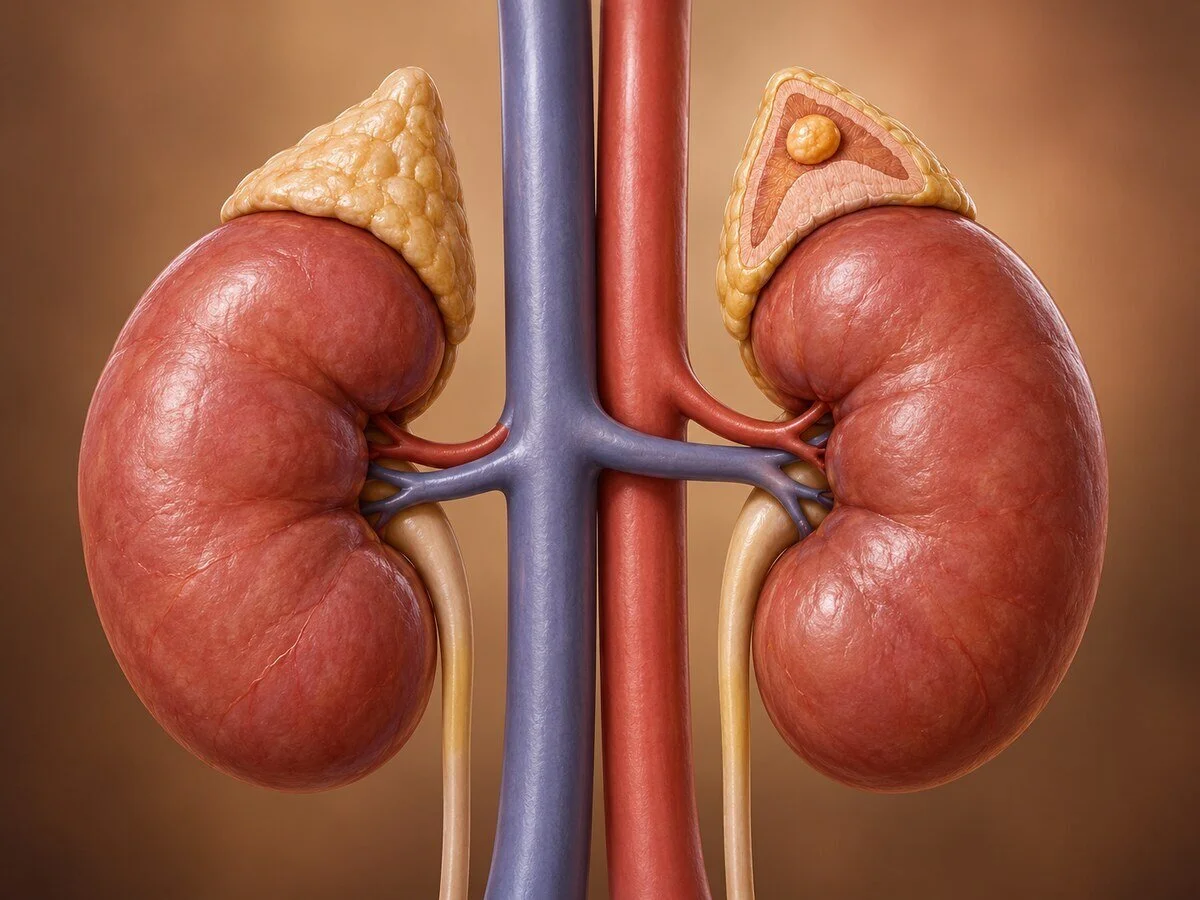
Primary aldosteronism is the commonest curable cause of high blood pressure. That sentence contains the entire clinical argument for this page, because it is also one of the most under-diagnosed conditions in medicine. It is present in something in the order of five to ten per cent of all people with hypertension, and in a fifth of those with resistant hypertension — yet only a small fraction are ever tested for it. The consequence is that large numbers of people take three or four blood pressure tablets for decades when a single operation, or one appropriate tablet, would have solved the problem.
How it develops
Aldosterone is produced by the zona glomerulosa of the adrenal cortex. Its normal role is to regulate blood volume: acting on the distal nephron, it promotes sodium and water reabsorption in exchange for potassium and hydrogen ion excretion. Its production is normally controlled by the renin-angiotensin system, which responds to blood pressure and sodium delivery to the kidney.
In primary aldosteronism, aldosterone is produced autonomously — independently of renin. The consequences follow directly from its physiology:
Sodium and water retention raises blood volume and therefore blood pressure.
Renin is suppressed by the raised pressure and volume, which is the biochemical signature of the condition: high aldosterone with low renin.
Potassium is lost, causing hypokalaemia — though, importantly, only a minority of patients have a low potassium. Relying on hypokalaemia to prompt testing is the single commonest reason the diagnosis is missed.
Hydrogen ion is lost, producing a metabolic alkalosis.
A phenomenon called aldosterone escape limits the sodium retention, which is why patients are hypertensive but not oedematous.
Crucially, aldosterone excess causes harm beyond its effect on blood pressure. It acts directly on the heart, blood vessels and kidneys to produce fibrosis, inflammation and remodelling. Patients with primary aldosteronism have significantly higher rates of atrial fibrillation, stroke, heart failure, left ventricular hypertrophy and kidney damage than patients with equivalent blood pressure from other causes. This is why identifying it matters even when the blood pressure is controlled by tablets — controlling the pressure does not block the direct tissue damage, whereas a specific aldosterone blocker or surgery does.
The causes
Bilateral adrenal hyperplasia — the commoner cause, accounting for roughly two thirds. Both glands over-produce. Treated medically.
Aldosterone-producing adenoma (Conn's adenoma) — a single benign tumour in one gland, accounting for roughly a third. Curable by removing that gland. Many carry somatic mutations in ion channel genes, most often KCNJ5.
Unilateral hyperplasia — behaves like an adenoma and is treated surgically.
Familial forms — several described, including glucocorticoid-remediable aldosteronism, which responds to low-dose dexamethasone; considered in young patients and in families with early strokes.
Adrenocortical carcinoma — a rare cause.
Distinguishing unilateral from bilateral disease is the pivotal decision, because it determines whether an operation can cure the patient.
Symptoms
There may be none beyond the hypertension itself.
Hypertension — often resistant, requiring three or more drugs; often of early onset; sometimes severe
where potassium is low: muscle weakness, cramps, fatigue, palpitations, constipation, excessive urination and thirst
headache
atrial fibrillation, sometimes the presenting problem
notably, no oedema, which distinguishes it from other causes of salt and water retention
Who should be tested
This is the practical heart of the matter, and the criteria are broader than most people assume:
hypertension resistant to three or more drugs
hypertension with hypokalaemia, whether spontaneous or provoked by a diuretic
hypertension with an adrenal incidentaloma
hypertension with obstructive sleep apnoea
hypertension with atrial fibrillation
hypertension of early onset, or a family history of early hypertension or stroke
severe hypertension (above 150/100)
a first-degree relative with primary aldosteronism
Several guidelines now argue for testing all newly diagnosed hypertensive patients at least once, on the grounds that the condition is common, the test is cheap, and the consequences of missing it are lifelong.
How the diagnosis is made
The pathway has three steps, and each must be completed in order.
1. Screening — the aldosterone-to-renin ratio
A raised ratio, with an aldosterone level that is not low, is the screening test. Interpretation requires attention to interfering factors:
Correct hypokalaemia first, since low potassium suppresses aldosterone and produces false negatives.
Mineralocorticoid receptor antagonists (spironolactone, eplerenone) must be stopped for four to six weeks.
Beta-blockers raise the ratio (false positives); ACE inhibitors, ARBs and diuretics lower it (false negatives). Where medication cannot be stopped, verapamil, hydralazine and alpha-blockers have minimal effect and can be substituted.
The sample is taken mid-morning after the patient has been upright for two hours.
2. Confirmation
Unless aldosterone is very high with spontaneous hypokalaemia and undetectable renin — in which case the diagnosis is established — confirmation is needed by a suppression test: saline infusion, oral sodium loading, fludrocortisone suppression or captopril challenge. Failure of aldosterone to suppress confirms autonomy.
3. Subtyping — the step that determines treatment
CT of the adrenals — necessary but not sufficient. CT is unreliable for subtyping: small adenomas are missed, and non-functioning incidentalomas are common and can be mistaken for the culprit lesion. Operating on the basis of CT alone removes the wrong gland in a meaningful proportion of cases.
Adrenal vein sampling (AVS) — the gold standard. Blood is sampled from both adrenal veins and the periphery, and aldosterone is measured relative to cortisol to correct for dilution, establishing whether secretion is lateralised. It is technically demanding — cannulating the right adrenal vein is the difficulty — and should be performed in an experienced centre. It is recommended for all patients considering surgery, with the reasonable exception of young patients (under about 35) with spontaneous hypokalaemia, marked aldosterone excess and a clear unilateral adenoma on CT, in whom non-functioning incidentalomas are rare.
Functional imaging with 11C-metomidate PET is an emerging non-invasive alternative showing promising results.
Genetic testing in young patients or where there is a suggestive family history.
Treatment
Unilateral disease — surgery
Laparoscopic adrenalectomy removes the affected gland. Outcomes are good and worth stating precisely, because they differ from what patients often expect:
Biochemical cure — normalisation of aldosterone and potassium — occurs in the great majority.
Complete cure of hypertension, with all medication stopped, occurs in roughly a third to a half.
Improvement, with fewer drugs and better control, occurs in most of the remainder.
Predictors of complete blood pressure cure are younger age, shorter duration of hypertension, fewer antihypertensive drugs and absence of established vascular damage — which is another argument for diagnosing it early. Persistent hypertension after successful surgery usually reflects coexisting essential hypertension and irreversible vascular remodelling, not surgical failure, and patients should be told this beforehand.
Potassium supplements and aldosterone antagonists are stopped at operation, and potassium and renal function are checked in the first week, as transient hypoaldosteronism can occur.
Bilateral disease — medical treatment
Mineralocorticoid receptor antagonists are the treatment, and they are specific treatment rather than simply blood pressure control — they block the direct effects of aldosterone on heart, vessels and kidney.
Spironolactone — effective and inexpensive; side effects in men include breast tenderness and enlargement, and in women menstrual irregularity, which are dose-related.
Eplerenone — more selective, with fewer hormonal side effects, but shorter-acting and more expensive.
Potassium and renal function are monitored, since hyperkalaemia is the principal risk.
A low-salt diet meaningfully improves control.
Newer non-steroidal antagonists and aldosterone synthase inhibitors are becoming available and are likely to change practice.
The aim of medical treatment is not only blood pressure control but an unsuppressed renin level, which indicates that the mineralocorticoid receptor is adequately blocked. Treating to blood pressure alone under-doses many patients and leaves the tissue damage unaddressed.
Recovery
Laparoscopic adrenalectomy is typically a one to two night stay with return to normal activity in two to four weeks. Blood pressure medication is reviewed and reduced in the days and weeks afterwards, and patients should be warned not to continue all their previous tablets unsupervised, as hypotension can result.
Follow-up
Blood pressure, potassium, renal function and aldosterone-renin status. For patients on medical treatment, lifelong monitoring with dose titration against renin. Cardiovascular risk factors are managed actively, since the excess risk from previous aldosterone exposure persists.
When to seek an opinion
If you have hypertension requiring three or more tablets, hypertension with a low potassium, hypertension diagnosed before the age of forty, hypertension with atrial fibrillation or sleep apnoea, or hypertension with an adrenal mass on a scan, ask specifically whether you have been tested for primary aldosteronism. It is a single blood test, and it is the commonest curable cause of high blood pressure.
Common questions
I have had high blood pressure for years. Could it really have a single treatable cause?
Quite possibly. This condition accounts for something in the order of one in ten to one in twenty cases of high blood pressure, and one in five among people needing several tablets. It is dramatically under-tested. A single blood test measuring two hormones is the starting point, and it is reasonable to ask for it.
My potassium is normal. Does that rule it out?
No, and this is the commonest reason the diagnosis is missed. Only a minority of people with this condition have a low potassium. Normal potassium is not a reason to skip the test.
Why do my blood pressure tablets need changing before the test?
Because several common blood pressure drugs directly affect the hormones being measured and can produce a falsely normal or falsely abnormal result. Some can be continued, others need substituting for a few weeks with drugs that do not interfere. This should be managed by the doctor arranging the test rather than by stopping medication yourself.
My scan shows a lump on one gland. Why is a further test needed before surgery?
Because harmless lumps on the adrenal glands are common, and the lump seen on the scan is not always the one producing the hormone. A procedure that samples blood from the veins of both glands directly shows which side is responsible. Without it, a proportion of patients would have the wrong gland removed, leaving them no better off and with one gland fewer.
Will surgery cure my blood pressure completely?
The hormone problem is corrected in almost everyone. Blood pressure returns entirely to normal without tablets in about a third to a half, and improves — usually with fewer tablets and better control — in most of the rest. Complete cure is more likely if you are younger and have had high blood pressure for a shorter time, because long-standing pressure causes changes in the blood vessels that do not reverse.
Why treat it if my blood pressure is already controlled on tablets?
Because the hormone itself damages the heart, blood vessels and kidneys directly, over and above the effect of the pressure. People with this condition have more strokes, heart failure and atrial fibrillation than people with the same blood pressure from other causes. Treating it specifically — by surgery or with a drug that blocks the hormone — addresses that, which ordinary blood pressure tablets do not.
What are the side effects of spironolactone?
The commonest are breast tenderness or enlargement in men and menstrual irregularity in women, both related to dose. An alternative drug, eplerenone, is more selective and causes these much less often. Potassium levels need checking, as they can rise too high on treatment.
Is it inherited?
Usually not, but several familial forms exist. Genetic testing is considered in people diagnosed young, where there is a family history of early high blood pressure or stroke, or where more than one family member is affected. First-degree relatives of someone diagnosed are worth testing with the simple blood test.
Related conditions
Other conditions of the adrenal glands covered on this site:
This page provides general information and does not replace an individual medical consultation. Assessment and treatment are decided for each patient after review of their history, examination and investigations.
