

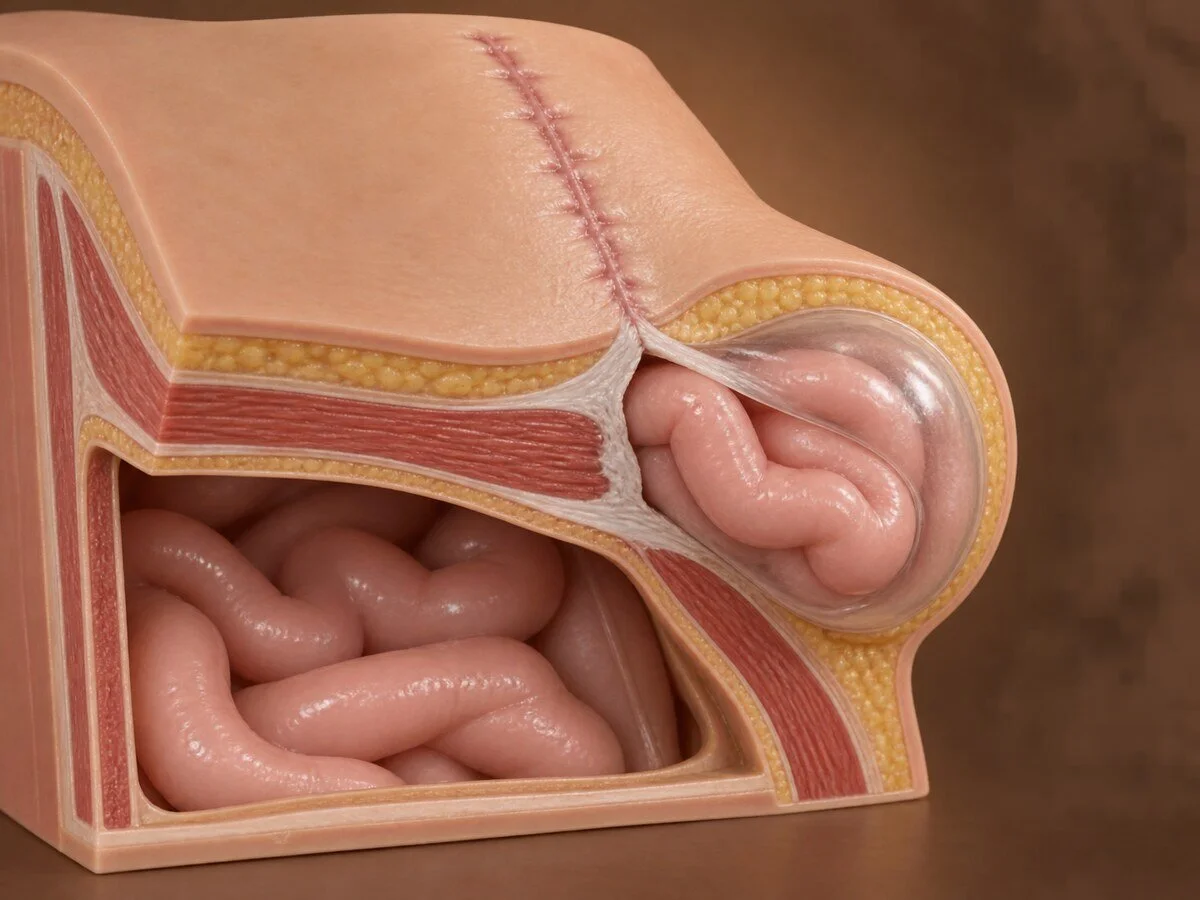
An incisional hernia is a hernia through the scar of a previous operation. It is the commonest complication of abdominal surgery, developing in a substantial proportion of patients after midline laparotomy, and it ranges from a small bulge causing little trouble to an enormous defect in which most of the abdominal contents lie outside the abdominal cavity. It is also the hernia most likely to recur after repair, which is why the assessment before surgery — and the preparation of the patient — matters more here than anywhere else in hernia practice.
How they form
A closed abdominal wound gains strength progressively as collagen is laid down and remodelled. A wound reaches perhaps a third of its final strength at three weeks and continues to strengthen for months. If, at any point in that process, the forces pulling the wound apart exceed its strength, the fascia separates — and once separated, it does not reunite.
Failure is usually established early, within the first month, long before any lump appears. This explains why most incisional hernias declare themselves within the first year, though they may enlarge for many years afterwards.
Why wounds fail
Technical factors
Suture technique. The evidence here is unusually clear: a small-bites technique — continuous closure with small, closely spaced bites of fascia only, using a slowly absorbable suture and a suture-length to wound-length ratio of at least 4:1 — substantially reduces incisional hernia compared with traditional large bites. Taking large bites of tissue strangulates it and the sutures cut through.
Incision type. Midline incisions carry a higher rate than transverse. Laparoscopic surgery carries a much lower rate overall, though port-site hernias occur, particularly at ports of 10mm or larger and at the umbilicus.
Emergency surgery, and wound infection, both substantially increase the risk.
Patient factors — and the first three are the ones that can actually be changed:
Obesity — raises pressure on the closure and impairs healing
Smoking — impairs collagen cross-linking and tissue oxygenation; one of the strongest modifiable risk factors
Poor glycaemic control in diabetes
malnutrition and low albumin; corticosteroids, chemotherapy and immunosuppression
chronic cough, constipation, prostatism, ascites
Connective tissue abnormality — an altered type I to type III collagen ratio and raised matrix metalloproteinase activity, present in many patients with hernias. Abdominal aortic aneurysm is strongly associated, reflecting the same underlying matrix defect.
Loss of domain
In very large hernias, a substantial proportion of the abdominal contents come to live permanently outside the abdominal cavity. The abdominal wall muscles, no longer opposed, retract laterally and shorten; the cavity contracts. Returning the contents then raises intra-abdominal pressure sharply, which can compromise breathing and kidney function — abdominal compartment syndrome. This is why very large hernias require specific preparation and planning rather than simply a bigger operation.
Symptoms
a bulge at or beside a surgical scar, increasing on standing, coughing or straining
discomfort, dragging, or a sense of the abdomen being unsupported
back pain, from loss of abdominal wall function
skin problems over large hernias — thinning, excoriation, ulceration
difficulty with posture, clothing and daily activity; significant effect on body image and quality of life, which is frequently underestimated by clinicians and is a legitimate reason for repair
intermittent obstruction from bowel caught in the sac
Emergency features: a painful, tense, irreducible bulge; vomiting, distension and absolute constipation; skin redness. Large hernias with wide necks strangulate less readily than small ones, but a small incisional hernia or a port-site hernia with a tight neck is at real risk.
How the diagnosis is made
Clinical examination establishes it. CT of the abdomen and pelvis is essential before repair of anything but the smallest hernia. It provides:
the size and number of defects — multiple defects along a scar are common
the width of the defect, which determines the technique
the volume of the hernia relative to the abdominal cavity — quantifying loss of domain
the state and thickness of the lateral abdominal wall muscles
the contents, and any previous mesh
Hernias are classified by the European Hernia Society according to site (midline or lateral) and width, which guides the approach.
Treatment
Preparing the patient — the part that determines the result
This deserves emphasis because it is where a durable repair is won or lost, and where patients often feel they are being refused rather than prepared:
Weight loss. Repair in a patient with a very high BMI has markedly higher rates of wound complication and recurrence. Structured weight loss, and in selected patients bariatric surgery before hernia repair, transforms the outcome.
Smoking cessation for at least four to six weeks beforehand. This is not a formality; it measurably reduces wound failure.
Glycaemic control, nutritional optimisation, and treatment of chronic cough and constipation.
Prehabilitation — exercise and respiratory preparation, which improves recovery.
Botulinum toxin injected into the lateral abdominal wall muscles several weeks before surgery, paralysing and lengthening them, so that the midline can be closed without tension. A significant advance for large hernias.
Preoperative progressive pneumoperitoneum — gradually insufflating the abdomen over days to stretch the cavity, used for extreme loss of domain.
The operation
The principles are to reduce the contents, close the fascial defect where possible to restore a functioning midline, and reinforce with mesh in a well-vascularised plane.
Where the mesh sits matters. The retromuscular (sublay) position — behind the rectus muscle and in front of the posterior sheath — gives the lowest recurrence and keeps mesh away from bowel. Onlay (above the fascia) has higher wound complication rates; intraperitoneal mesh contacts bowel and carries adhesion and fistula risk, and is used more selectively than it once was.
Component separation — for large defects that cannot be closed directly. Anterior component separation releases the external oblique; posterior component separation with transversus abdominis release (TAR) divides the transversus abdominis muscle from within, allowing wide medial advancement and creating a large retromuscular space for mesh. TAR has become the workhorse operation for complex abdominal wall reconstruction.
Laparoscopic and robotic repair — suitable for small and medium defects; robotic techniques now allow retromuscular mesh placement and TAR minimally invasively, combining the durability of open reconstruction with faster recovery.
Mesh choice — synthetic polypropylene in clean fields; biological or biosynthetic mesh considered in contaminated fields, though the evidence for their superiority is weaker than the marketing suggests.
Complex abdominal wall reconstruction is a subspecialty, and outcomes are better in units that do it regularly.
Recovery
Recovery depends entirely on the size of the repair. A small repair is a day case with a one-to-two week recovery. A large reconstruction with component separation involves five to ten days in hospital, drains, an abdominal binder, and two to three months before full activity.
Expected and common: seroma, particularly after large dissections, which may persist for weeks and should not be aspirated unnecessarily because of infection risk; bruising; a firm, numb area over the repair; and a sensation of tightness that eases over months. Wound infection is the principal complication and the strongest predictor of recurrence.
Recurrence rates after modern retromuscular mesh repair are considerably better than historical figures, but this remains the hernia most likely to recur, and patients should be told so honestly.
Prevention
Worth stating, since many readers will be facing abdominal surgery rather than an existing hernia: small-bites fascial closure, avoiding midline incisions where a transverse one will do, prophylactic mesh at closure in very high-risk patients, preventing wound infection, stopping smoking before surgery, and weight optimisation all reduce the risk.
When to seek an opinion
A bulge at a surgical scar should be assessed, even if painless, since small ones are easier to repair than large ones and they enlarge. A painful, tense, irreducible bulge, or one accompanied by vomiting and distension, requires emergency assessment.
Common questions
Why did this happen? Did something go wrong with my operation?
Usually not. Wound failure is the commonest complication of abdominal surgery and depends heavily on factors other than technique — whether the operation was an emergency, whether the wound became infected, weight, smoking, diabetes, steroids, and the quality of your own connective tissue. It is common enough that it is discussed as a recognised risk of any abdominal operation.
Will it get worse?
Generally yes, slowly. Incisional hernias tend to enlarge over years, and a large one is a considerably bigger operation with a higher complication rate than a small one. That is a reasonable argument for repairing it while it is manageable.
Why do I have to lose weight and stop smoking first?
Because these two things have more influence on whether the repair lasts than almost anything the surgeon does. Operating on a heavy smoker with a very high BMI produces a high rate of wound problems and recurrence. This is not a way of putting you off — it is the part of the treatment that determines whether it works.
What is this injection into my abdominal muscles before surgery?
Botulinum toxin, given some weeks beforehand, temporarily relaxes and lengthens the side muscles of the abdominal wall, which have shortened and pulled apart. This allows the midline to be brought together without excessive tension at operation. It has made large hernias considerably more repairable than they used to be.
Do I definitely need mesh?
For almost all incisional hernias, yes. Closing the defect with stitches alone has a very high rate of recurrence, because the tissue that failed the first time is being asked to hold again. Where the mesh is placed — ideally behind the muscle rather than on top of it — also makes a real difference to how well the repair lasts.
Can it be done by keyhole surgery?
Often, for small and medium hernias. Robotic techniques now also allow the more durable behind-the-muscle repairs and the muscle-release operations to be done through small incisions. Very large or complex hernias are still frequently better served by an open reconstruction.
Will it come back?
This is the hernia most likely to recur, and you deserve an honest answer rather than reassurance. Modern techniques with mesh placed behind the muscle have improved results considerably, but the risk is real, and it is strongly influenced by weight, smoking, diabetes and wound infection — which is why the preparation matters.
Is the swelling after surgery a recurrence?
Usually not. Fluid collects in the space the hernia occupied and can persist for weeks, feeling much like the original bulge. It normally settles without treatment, and draining it carries a risk of introducing infection, so it is generally left alone unless it is causing real trouble.
Related conditions
Other conditions of the hernias & abdominal wall covered on this site:
This page provides general information and does not replace an individual medical consultation. Assessment and treatment are decided for each patient after review of their history, examination and imaging.
