

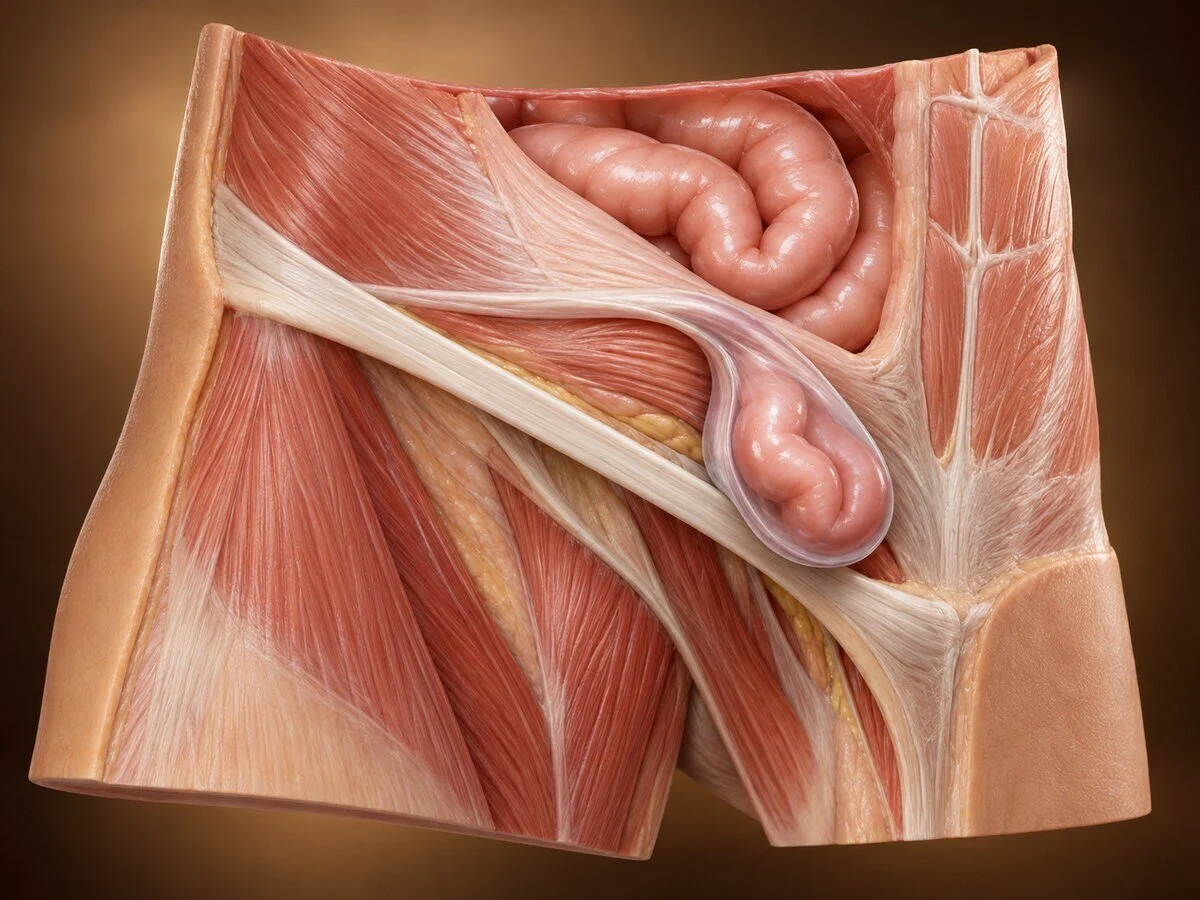
An inguinal hernia is a protrusion of abdominal contents through a weakness in the groin. It is the commonest hernia by a wide margin, and inguinal hernia repair is one of the most frequently performed operations in the world. Precisely because it is so common, it is often treated as a routine matter — yet the decisions involved are not trivial: whether to operate at all, which repair to use, and how to minimise the one complication that genuinely affects quality of life afterwards, which is chronic groin pain rather than recurrence.
How they form
The inguinal region has an inherent weakness created during development. In the fetus, the testis descends from the abdomen through the abdominal wall into the scrotum, dragging a peritoneal pouch — the processus vaginalis — with it. This normally closes. The passage it leaves, the inguinal canal, remains a defect in an otherwise continuous wall.
Two distinct mechanisms produce hernias here, and they are distinguished by their relationship to the inferior epigastric vessels:
Indirect hernia — passes lateral to the inferior epigastric vessels, through the deep inguinal ring, following the path of testicular descent. It results from persistence of the processus vaginalis. It is the commonest type at all ages, and the type seen in children and young adults. It may descend into the scrotum.
Direct hernia — pushes forward medial to the inferior epigastric vessels, through a weakened posterior wall of the inguinal canal (Hesselbach's triangle). It is acquired, related to weakening of the transversalis fascia, and is a condition of later life. It rarely reaches the scrotum.
The distinction matters surgically but far less to the patient than is often implied: both are repaired by the same operations, and the surgeon frequently finds both on the same side.
Why the wall gives way
Two factors combine. The first is mechanical: repeated raised intra-abdominal pressure from chronic cough, straining at stool, prostatic obstruction, heavy manual work, obesity or ascites. The second, and increasingly recognised as the more important, is a defect in connective tissue. Patients with hernias show altered collagen — a reduced ratio of mature type I to immature type III collagen — and increased matrix metalloproteinase activity degrading the extracellular matrix. This is why hernias occur in people with no obvious strain, why smoking (which impairs collagen cross-linking) is a risk factor, why they are associated with connective tissue disorders and with abdominal aortic aneurysm, and why they run in families.
It also explains why simply sewing the tissue together — the historical repairs — failed so often, and why reinforcement with mesh reduced recurrence so dramatically. The native tissue is the problem.
Symptoms
a lump in the groin, appearing on standing, coughing or straining, and often disappearing on lying down
a dragging or aching discomfort, typically worse at the end of the day or after activity
a sensation of heaviness or pressure
swelling extending into the scrotum in larger indirect hernias
a proportion are asymptomatic and found incidentally
Warning features requiring emergency assessment: a lump that becomes painful, firm and cannot be pushed back (incarceration); with vomiting, distension and absolute constipation (obstruction); or with severe pain, redness of the overlying skin, fever and systemic upset (strangulation, where the blood supply to the contents is cut off). Strangulation is a surgical emergency.
The lifetime risk of strangulation in an inguinal hernia is low — considerably lower than in a femoral hernia — which is what underpins the option of watchful waiting discussed below.
How the diagnosis is made
Usually clinically: examination with the patient standing and coughing demonstrates the hernia in most cases. Distinguishing inguinal from femoral hernia matters, since femoral hernias strangulate far more readily and are repaired promptly; the key is the relation of the lump to the pubic tubercle — inguinal hernias appear above and medial to it, femoral hernias below and lateral.
Where examination is equivocal, particularly in obese patients or in groin pain without an obvious lump, ultrasound with a Valsalva manoeuvre, or CT or MRI, is used. MRI is the most informative where the question is whether groin pain is hernia-related at all, since it also shows the adductor and pubic pathology that commonly mimics it.
Treatment
Do all hernias need repairing?
No, and this deserves clear statement because patients are often told otherwise. For a minimally symptomatic or asymptomatic inguinal hernia in a man, watchful waiting is a safe and evidence-based option: trials show the risk of acute complication is low. However, the majority of such patients cross over to surgery within five to ten years because symptoms develop, so watchful waiting is best understood as a deferral rather than a permanent alternative.
Repair is advised for symptomatic hernias, for hernias that cannot be reduced, and — importantly — for all femoral hernias and for hernias in women, where the femoral component and the risk of strangulation are considerably higher.
Trusses are not treatment. They do not cure a hernia, may cause skin damage and atrophy of the tissues, and have no place in modern practice other than in patients genuinely unfit for any operation.
The operations
All effective modern repairs reinforce the posterior wall of the inguinal canal with mesh, which becomes incorporated by fibrous tissue.
Open mesh repair (Lichtenstein) — a flat mesh sutured over the posterior wall through a groin incision. Reliable, reproducible, performable under local anaesthetic, and the standard against which others are measured. Particularly suitable for large scrotal hernias, for patients unfit for general anaesthesia, and in settings where laparoscopic expertise is unavailable.
Laparoscopic repair — placing mesh in the preperitoneal space behind the defect, where intra-abdominal pressure holds it in place. Two approaches: TEP (totally extraperitoneal, staying outside the abdominal cavity) and TAPP (transabdominal preperitoneal, entering the abdomen). Advantages: less postoperative pain, faster return to work and normal activity, lower rates of chronic pain, and the ability to repair both sides through the same three small incisions. It is the preferred approach for bilateral hernias and for recurrent hernias after previous open repair, since it approaches from an unscarred plane.
Robotic repair — essentially a laparoscopic preperitoneal repair with improved instrument articulation.
Tissue repairs without mesh (Shouldice, Bassini) — largely superseded because of higher recurrence, but the Shouldice repair in expert hands gives good results and remains an option for patients who wish to avoid mesh, which some do.
Both open and laparoscopic repairs are good operations. The choice depends on whether the hernia is bilateral or recurrent, on the patient's occupation and how quickly they need to return to work, on previous surgery, on fitness for general anaesthesia, and on the surgeon's experience — which is itself a legitimate factor, since outcomes for laparoscopic repair are experience-dependent.
Mesh
Mesh has been the subject of public concern, largely arising from problems with mesh used in a different setting — transvaginal pelvic floor mesh — which should not be conflated with inguinal hernia mesh. Flat polypropylene mesh for groin hernia repair has a long record and reduces recurrence by roughly half compared with suture repair. Complications occur — infection, chronic pain, and rarely migration or erosion — but are uncommon. Patients who raise the subject deserve a straight answer rather than either dismissal or alarm, and non-mesh repair remains an option to discuss.
Emergency repair
An incarcerated or strangulated hernia requires urgent surgery. The contents are assessed for viability and non-viable bowel resected. Mesh is used with caution where bowel has been resected and contamination is present.
Recovery
Most repairs are day-case procedures. Return to desk work is typically one to two weeks after laparoscopic repair and two to three weeks after open repair; heavy manual work takes four to six weeks. Modern advice is to return to normal activity guided by comfort rather than by arbitrary lifting restrictions, since early activity does not increase recurrence.
Expected after surgery: bruising, sometimes extending into the scrotum and looking alarming while being harmless; a firm ridge along the repair as the mesh incorporates, which softens over months; and a seroma — a collection of fluid in the space the hernia occupied, which can feel exactly like the hernia has returned but resolves over weeks.
Chronic groin pain
This is the most important long-term issue and is under-discussed. Persistent pain beyond three months affects a minority of patients, and in a small proportion is significant. It arises from injury or entrapment of the ilioinguinal, iliohypogastric or genitofemoral nerves, or from the inflammatory response around the mesh. Risk is reduced by identifying and protecting the nerves during open repair (or deliberately dividing rather than leaving a nerve traumatised), by avoiding tacks near nerves in laparoscopic repair, and by laparoscopic approach in general. Treatment involves analgesia, neuropathic agents, nerve blocks and, in selected cases, surgery.
Recurrence rates after mesh repair are low — in the low single figures.
When to seek an opinion
A new groin lump should be assessed, both to confirm what it is and to distinguish inguinal from femoral hernia. A hernia that becomes painful, tense and irreducible, or is accompanied by vomiting or abdominal distension, is an emergency and requires immediate attention.
Common questions
Do I have to have it repaired?
Not necessarily, if it is a men's inguinal hernia causing little or no trouble. Watching and waiting is safe, because the risk of a sudden serious complication is low. That said, most people in this situation eventually come to surgery because symptoms develop over the years. Hernias in women, and femoral hernias, should be repaired, as the risk of complication is significantly higher.
Will it get bigger if I leave it?
Usually, slowly. Hernias do not resolve on their own and generally enlarge over time. A very large hernia is a more substantial operation than a small one, which is a reasonable argument for repairing it while it is straightforward rather than waiting for years.
Is mesh safe?
The mesh used for groin hernia repair has a long track record and halves the chance of the hernia returning. It is not the same material or the same application as the vaginal mesh that caused well-publicised problems, and the two should not be confused. Complications from hernia mesh occur but are uncommon. If you would prefer a repair without mesh, that option exists and is worth discussing.
Keyhole or open — which is better?
Both are good operations and neither is universally superior. Keyhole repair usually means less pain and a faster return to work, and is the clearly better choice for hernias on both sides or for one that has come back after previous open surgery. Open repair can be done under local anaesthetic, suits very large hernias, and is reliable. Your circumstances and your surgeon's experience both properly influence the decision.
How soon can I lift things or go back to the gym?
Sooner than most people expect. Current advice is to be guided by comfort rather than by fixed restrictions, because returning to activity early does not make the hernia come back. Most people return to desk work within one to two weeks and to full activity, including heavy lifting, within four to six.
The lump has come back after my operation. Is it a recurrence?
Often not. A collection of fluid frequently forms in the space the hernia used to occupy and feels very much like the hernia itself. It settles over several weeks. It is worth having it checked rather than assumed, but true recurrence after mesh repair is uncommon.
Will it affect fertility or sexual function?
Very rarely. The vas deferens and the testicular blood vessels run through the same canal and are identified and preserved during the operation. Damage is uncommon, and in men with a hernia on one side there is no measurable effect on fertility. Bruising and swelling of the scrotum in the first couple of weeks is common and harmless.
Why do I still have pain months afterwards?
A minority of people develop persistent groin pain after hernia repair, from irritation of one of the small nerves crossing the area or from the healing around the mesh. It is worth reporting rather than enduring, because there are effective treatments — including specific nerve blocks — and it is better assessed early.
How do I know if a lump in my groin is a hernia?
A hernia typically appears on standing, coughing or straining and often disappears when you lie down, with a dragging ache that is worse at the end of the day. Examination usually confirms it; when it is uncertain, ultrasound, CT or MRI is used. A groin lump that becomes painful, firm and will not go back in needs emergency assessment.
Related conditions
Other conditions of the hernias & abdominal wall covered on this site:
This page provides general information and does not replace an individual medical consultation. Assessment and treatment are decided for each patient after review of their history and examination.
