

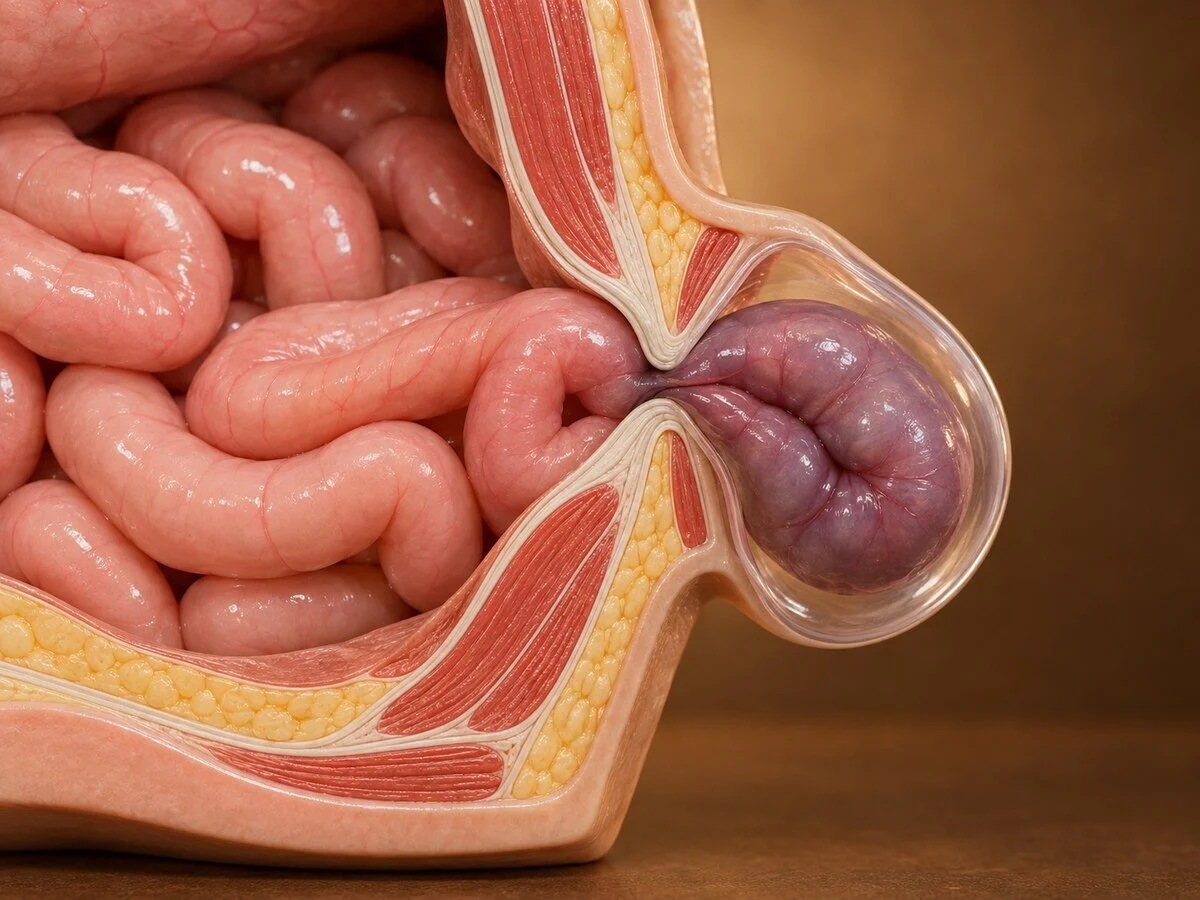
Most hernias are a nuisance rather than a danger. A small proportion become an emergency, and this page is about that minority — what happens, how to recognise it, and why the time between recognising it and treating it is the single factor that determines the outcome. If you have a hernia that has suddenly become painful, firm and impossible to push back, the practical advice is simple: go to an emergency department now rather than waiting to see whether it settles.
The terms, and why they matter
These words are often used loosely and they describe different situations:
Reducible — the contents go back into the abdomen when you lie down or push gently. The normal state of most hernias.
Irreducible (incarcerated) — the contents will not go back. This may have been the case for years, with adhesions holding omentum in the sac, and is not in itself an emergency. A newly irreducible hernia is a different matter.
Obstructed — a loop of bowel in the sac is kinked or compressed so that its lumen is blocked. The patient develops intestinal obstruction. The blood supply may still be intact at this stage.
Strangulated — the blood supply to the contents is cut off. The tissue becomes ischaemic, then necrotic, then perforates. This is the emergency.
How strangulation happens
The sequence is a vicious circle driven by the mechanics of a narrow neck.
A loop of bowel or a knuckle of omentum passes through a defect with a tight, often fibrous, rim.
The contents swell slightly — from oedema, or from gas and fluid accumulating in an obstructed loop — and can no longer pass back through the neck.
Venous and lymphatic drainage is obstructed first, because veins and lymphatics are thin-walled and collapse at lower pressures than arteries.
Blood continues to enter through the arteries but cannot leave. The loop becomes engorged, and fluid leaks into the wall and the sac. It swells further, tightening the neck.
Arterial inflow eventually fails. The tissue becomes ischaemic, turns from congested purple to black, and the wall loses its integrity.
Bacteria translocate across the dying wall into the sac and bloodstream, producing sepsis. Eventually the bowel perforates.
The whole process can run in hours. This is why the rule in hernia surgery is that the clock starts when the pain starts.
Which hernias are most at risk
Risk relates to the tightness of the neck rather than the size of the lump:
Femoral hernias — by far the highest risk. The femoral canal is bounded on three sides by rigid ligament and bone, and a significant proportion present as an emergency without the patient ever having noticed a hernia. This is why all femoral hernias are repaired promptly.
Obturator hernias — rare, through a rigid bony canal, and typically presenting with obstruction in a thin elderly woman with no visible lump at all.
Umbilical and epigastric hernias — narrow fibrous necks.
Small incisional and port-site hernias — a small defect with a firm rim is more dangerous than a large one.
Indirect inguinal hernias — higher risk than direct hernias, which have a broad neck.
Conversely, a very large hernia with a wide neck, though unsightly, strangulates comparatively rarely.
Two patterns that catch people out
Richter's hernia — only part of the circumference of the bowel wall is caught in the defect. The lumen stays open, so the patient continues to pass stool and flatus and does not obstruct, while the trapped portion of wall dies. Normal bowel function is therefore no reassurance in a tender, irreducible hernia. Richter's hernias are particularly associated with femoral and obturator hernias.
Maydl's hernia — a "W" of bowel, where two loops lie in the sac and the connecting loop lies back inside the abdomen. The strangulated segment is the one inside the abdomen, so the loops visible in the sac may look perfectly healthy. This is why the abdomen must be inspected when a hernia is explored and the findings do not fit.
Symptoms
Incarceration:
a hernia that will no longer go back
increasing ache or discomfort
a firmer, more tense lump
Obstruction:
colicky abdominal pain
vomiting
abdominal distension
absolute constipation — no stool and no flatus
Strangulation:
severe, constant pain in the hernia, replacing the earlier colicky pain
marked tenderness over the lump, with the patient unwilling to let it be touched
redness or discolouration of the overlying skin
fever, rapid pulse, feeling profoundly unwell
signs of peritonitis if perforation has occurred
In elderly, frail and immunosuppressed patients, and in those on steroids, these signs may be muted, and the presentation is often late.
How the diagnosis is made
It is a clinical diagnosis, and a patient with a tender irreducible hernia, obstruction and systemic upset should go to theatre without waiting for imaging.
Where the picture is unclear, or the patient has obstruction with no obvious cause, CT is the investigation of choice. It demonstrates the hernia, its contents, the calibre of bowel above and below, and features of ischaemia — bowel wall thickening, reduced enhancement, free fluid, mesenteric fat stranding and, late, gas within the wall. Critically, CT identifies the hernias that cannot be seen or felt: obturator, Spigelian, lumbar and small femoral hernias in obese patients. A blood lactate provides supporting evidence of ischaemia.
In any patient with unexplained intestinal obstruction, all the hernial orifices must be examined. A missed femoral or obturator hernia is a classical and still-occurring cause of delayed diagnosis in elderly women.
Treatment
Initial management
Nil by mouth, intravenous fluids, nasogastric decompression if vomiting, analgesia, antibiotics, correction of electrolytes, catheterisation, and urgent surgical assessment. Resuscitation and surgery proceed in parallel; a strangulated hernia is not made safer by prolonged preparation.
Attempted reduction
Gentle reduction with analgesia may be appropriate for a recently incarcerated hernia without signs of strangulation, and, if successful, allows a planned repair within days. It is contraindicated where strangulation is suspected, because of the risk of reduction en masse — pushing the hernia, sac, constricting ring and all, back into the abdomen, so that the lump disappears while the bowel remains strangulated inside. The patient appears improved and the diagnosis is lost. Forceful reduction is never appropriate.
Surgery
The principles:
Expose the sac and control the contents before releasing the constriction, so that potentially non-viable bowel is not lost back into the abdomen unexamined.
Divide the constricting ring — with care in a femoral hernia, where an aberrant obturator artery may run alongside the lacunar ligament.
Assess viability. Warm packs and a few minutes of observation; viable bowel regains colour, sheen and peristalsis, and its mesenteric pulsation returns. Fluorescence imaging with indocyanine green is increasingly used to assess perfusion objectively.
Resect non-viable bowel and restore continuity, or form a stoma where the patient is unstable or the bowel oedematous.
Repair the defect. Mesh is used in clean fields. Where bowel has been resected and the field is contaminated, the decision is individualised — primary tissue repair or biological mesh may be preferred, though evidence increasingly supports synthetic mesh in many clean-contaminated cases.
Laparoscopy is used both diagnostically — to inspect bowel that has already reduced — and therapeutically in selected cases.
Recovery
A hernia reduced and repaired before strangulation follows the usual elective course. Where bowel has been resected, recovery is considerably longer — often a week or more in hospital, sometimes with critical care, and a recovery measured in months, particularly in elderly patients.
The contrast between elective and emergency repair is stark, and it is the whole argument for repairing a hernia at a time of one's choosing rather than waiting for it to declare itself.
When to seek help urgently
Go to an emergency department immediately if a hernia:
becomes suddenly painful, firm and cannot be pushed back
is accompanied by vomiting, abdominal distension, or inability to pass stool or wind
has red, discoloured or shiny skin over it
is accompanied by fever or feeling very unwell
Do not wait to see if it settles overnight. The tissue can die within hours, and the difference between a straightforward operation and a bowel resection is often a matter of how long the patient waited.
Common questions
How do I know if my hernia is becoming dangerous?
The three features that matter are: it will not go back when it previously did; it is painful and tender rather than just uncomfortable; and you feel unwell, are vomiting, or cannot pass wind. Any of these means immediate assessment rather than a routine appointment.
My bowels are still working. Does that mean it is safe?
Not necessarily. Sometimes only part of the wall of the bowel is trapped, so food continues to pass normally while the trapped portion loses its blood supply. Normal bowel function is reassuring but does not rule out a problem, particularly with a hernia low in the groin.
Should I try to push it back in myself?
You can try gently while lying down and relaxed if the hernia is uncomfortable but not acutely painful. Never push forcefully, and do not persist if it is very tender, because forcing it can push the trapped bowel back inside still strangulated, which hides the problem and delays treatment. If it will not go back easily, seek help.
How long do I have?
Hours, not days. The blood supply fails progressively once the contents become trapped, and the tissue can die within a few hours. The time between symptoms starting and treatment is the main thing determining whether a piece of bowel has to be removed.
Which hernias are most likely to do this?
Those with narrow, rigid openings — particularly femoral hernias in the upper thigh, which is why those are repaired without delay. Small hernias with tight rims are more dangerous than large ones with wide openings, which is the opposite of what most people assume.
Will I need a piece of bowel removed?
Only if the trapped segment has lost its blood supply irreversibly. If you are treated before that point, the bowel simply recovers once released and the hernia is repaired as usual. This is precisely why early attendance matters so much.
Is it safe to use mesh in an emergency?
Usually yes, and mesh is used in most emergency repairs where the field is clean. Where bowel has had to be removed and there is contamination, the decision is made individually at the time, and a repair without synthetic mesh may be preferred.
Could this have been avoided?
Often, yes — by repairing the hernia electively. A planned repair is usually a day-case procedure with a short recovery. An emergency repair with bowel resection is a major operation with a real mortality, particularly in older patients. That difference is the strongest argument for dealing with a hernia at a time of your choosing.
What is the difference between an incarcerated and a strangulated hernia?
An incarcerated hernia is one whose contents will not go back in. A strangulated hernia is one in which the blood supply to the trapped contents has been cut off, so the tissue starts to die. Incarceration can be long-standing and is not always an emergency; strangulation always is. A hernia that has newly become stuck and painful should be treated as possible strangulation until proven otherwise.
How long is the recovery after surgery for a strangulated hernia?
If the hernia is repaired before the bowel is damaged, recovery is similar to a planned repair. If a section of bowel has to be removed, it is considerably longer: often a week or more in hospital and several months to full recovery, particularly in older patients.
Related conditions
Other conditions of the hernias & abdominal wall covered on this site:
This page provides general information and does not replace an individual medical consultation. A painful, irreducible hernia is a medical emergency requiring immediate hospital assessment.
