

Pancreatic pseudocyst and pancreatic fluid collections
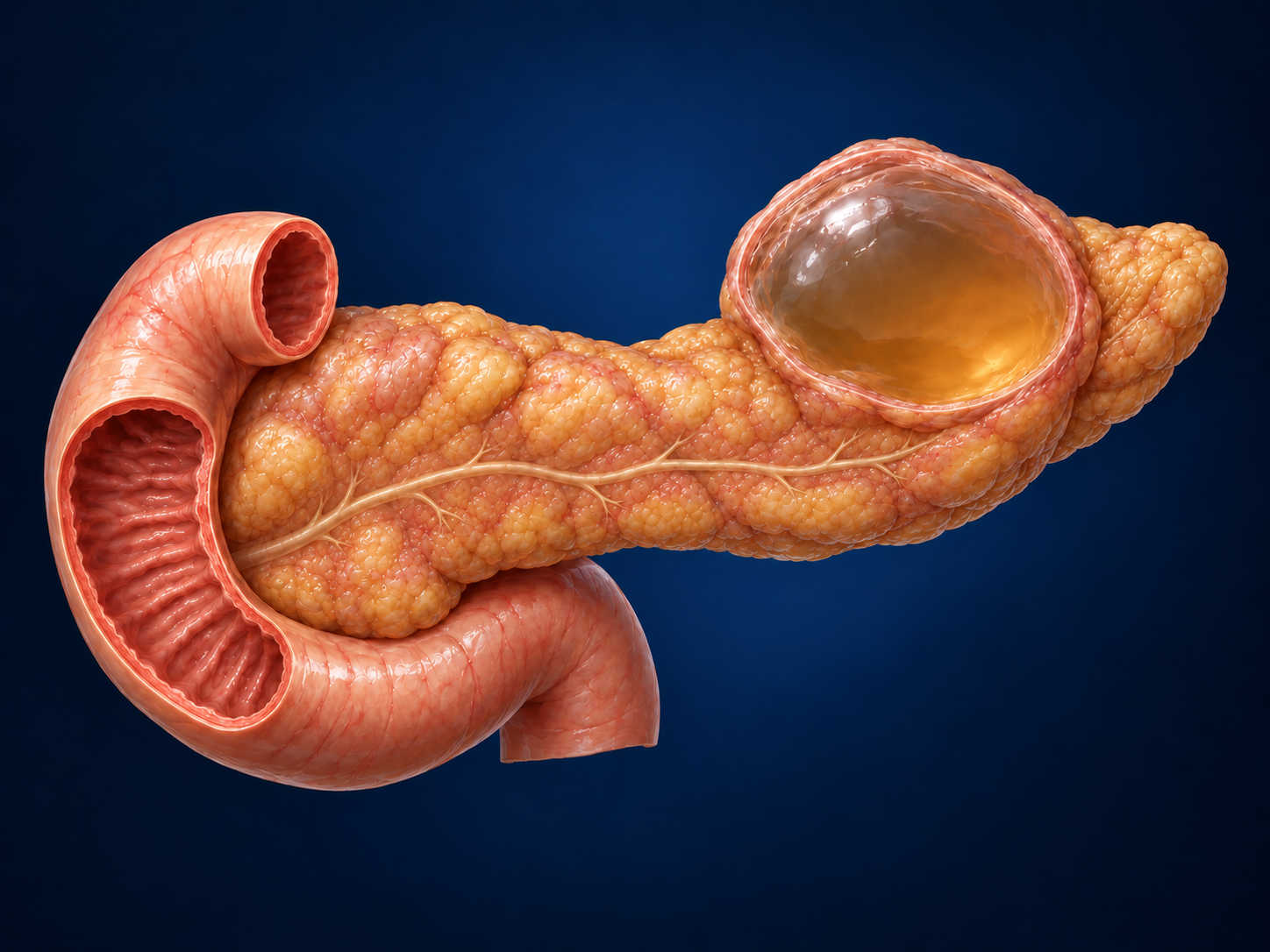
A pancreatic pseudocyst is a localized collection of fluid that forms around the pancreas after inflammation or injury to the pancreas.
Unlike a true pancreatic cyst or a cystic neoplasm, it does not have a normal epithelial lining. It is surrounded by fibrous and inflammatory tissue and contains mainly pancreatic fluid.
Not every fluid collection after pancreatitis is a pseudocyst. During the first weeks, acute peripancreatic fluid collections may be present, while after necrotizing pancreatitis, walled-off necrosis may develop; this contains both fluid and necrotic tissue. Correct distinction is important because it determines the most appropriate management.
How it develops
A pseudocyst develops most often after acute pancreatitis, particularly when the inflammation was significant or was associated with leakage of pancreatic fluid. It may also be associated with chronic pancreatitis, in which long-standing inflammation and strictures or stones in the pancreatic duct increase pressure within the gland.
The collection needs time to organize. A true pseudocyst usually develops a defined wall after approximately four weeks. It may communicate with the pancreatic duct or place pressure on the stomach, duodenum, or bile ducts.
Symptoms
Small pseudocysts may cause no symptoms and may be found incidentally during follow-up after pancreatitis. When symptoms occur, the most common are persistent upper abdominal or back pain, nausea, vomiting, a feeling of fullness, and early satiety.
Large or complicated collections may cause obstruction of the gastric outlet or bile duct, resulting in vomiting or jaundice. Fever, chills, and worsening pain may suggest infection. Less commonly, bleeding may occur into the collection or from a neighboring blood vessel.
Diagnosis
Contrast-enhanced CT is usually the main investigation. It shows the size, location, wall, and relationship of the collection to the stomach, duodenum, blood vessels, and pancreatic duct. MRI with MRCP is especially helpful when more detailed assessment of the pancreatic duct is needed or when there is uncertainty about the contents of the collection.
Endoscopic ultrasound may confirm suitability for endoscopic drainage and allow safe access while avoiding blood vessels. When the appearance is not typical or a cystic neoplasm is suspected, assessment is more specialized.
Treatment
An asymptomatic, uncomplicated pseudocyst usually does not require immediate intervention, irrespective of its size. It is monitored with imaging and clinical review. The decision to treat is not based on a measurement in centimeters alone, but on symptoms, the evolution of the collection, and potential complications.
Drainage is considered when there is persistent pain; nausea or vomiting due to compression of the stomach; jaundice due to biliary compression; infection; bleeding; rapid enlargement; or diagnostic uncertainty. In suitable cases, endoscopic drainage through the stomach or duodenum, guided by endoscopic ultrasound, is often the preferred minimally invasive approach.
Percutaneous drainage may be appropriate in selected situations, particularly when endoscopic access is not feasible or when the patient is critically unwell. Surgical management — laparoscopic, robotic, or open — has a role when the collection is not suitable for endoscopic treatment, when it recurs, or when pathology of the pancreatic duct needs to be corrected at the same time. The operation usually creates internal drainage into the stomach or small intestine.
The cause of pancreatitis is addressed at the same time. For example, after gallstone pancreatitis, cholecystectomy may be planned; in chronic pancreatitis, alcohol intake, smoking, and any pancreatic duct problem are assessed.
Frequently asked questions
Is a pseudocyst cancer?
No. A pseudocyst is a complication of pancreatic inflammation or injury. However, because some cystic neoplasms can resemble a pseudocyst, it is important to confirm the diagnosis.
Will it go away on its own?
Many pseudocysts reduce in size or remain stable without intervention. The likelihood of spontaneous resolution depends on the cause, duration, communication with the pancreatic duct, and the presence of symptoms.
Does it need drainage because it is large?
Not necessarily. Intervention is based mainly on symptoms and complications, not on size alone.
Is endoscopic or surgical treatment better?
Endoscopic drainage is often the first option when the anatomy is suitable. Surgical treatment remains very effective and is the right solution in certain complex cases.
When should I seek urgent help?
High fever, chills, sudden worsening of pain, faintness, vomiting blood, black stools, or jaundice require urgent medical assessment.
This information is general and does not replace individualized medical assessment.
